
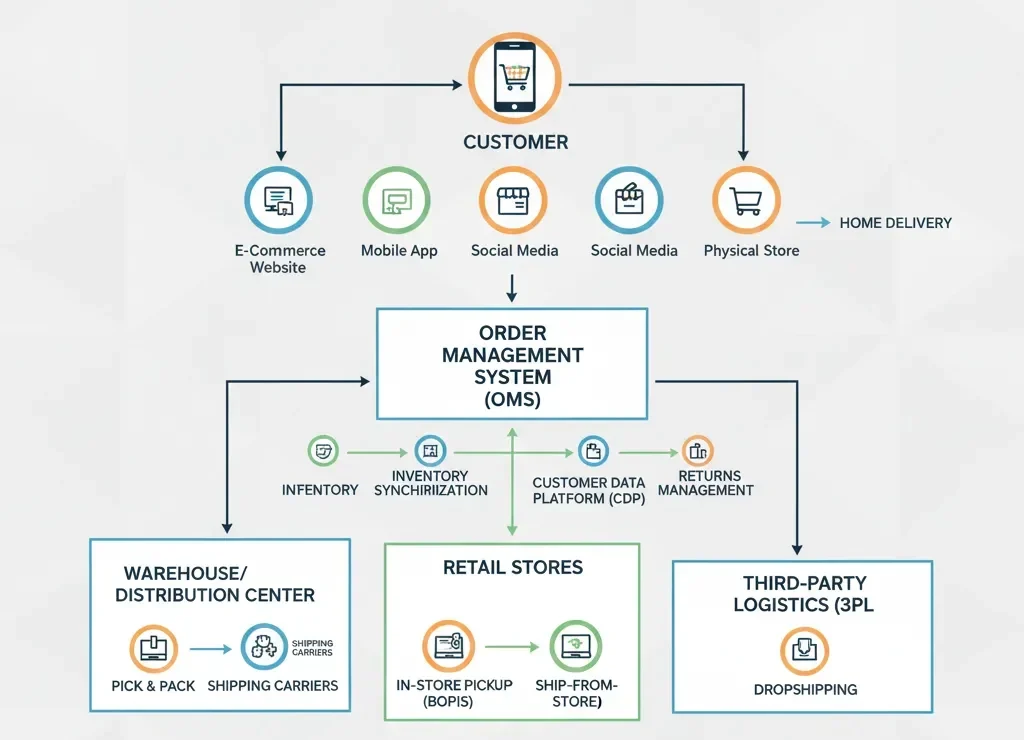
Compare ship-from-store and DC picking to optimise omnichannel fulfilment. Corless Logistics delivers warehousing, storage and distribution expertise.
Retail has sprinted into a world where customers expect fast, flexible delivery choices—click & collect today, doorstep delivery tomorrow. Choosing the right approach to omnichannel fulfilment can make or break margins, customer satisfaction and scalability. Two popular methods: Ship-from-Store and Distribution Centre (DC) picking—both shine in different scenarios.
Here’s a practical comparison to help you decide what’s right for your network in Australia.
When Ship-from-Store Wins: Turning Shops into Mini DCs
Ship-from-Store taps your retail footprint to fulfil nearby online orders, monetising on-hand stock, reducing aged inventory and shrinking metro delivery lead times. With shorter travel distances, last-mile costs drop, and delivery promises tighten, lifting conversion and loyalty. Store staff pick from the shopfloor or a back-room buffer and hand off to local couriers for same-day or next-day delivery.
The flipside? Accuracy depends on real-time stock visibility and disciplined store processes. Variability in staff availability, store layouts, and peak walk-in traffic can create pick delays or substitutions. To keep the customer promise, retailers often cap volumes per store, set clear cut-offs, and use rules to route orders to the “best” location based on distance, capacity and available-to-promise logic.
The Strength of DC-Picking: Scale, Control and Cost Discipline
DC-picking centralises inventory and labour, leveraging automation, racking density and consistent processes. It’s the steady workhorse when you’re chasing unit cost efficiency and reliable SLA performance, especially for medium-to-high order volumes. With better slotting, conveyorised flows and a robust WMS, DCs excel at accuracy and batching, which lowers cost per order and reduces split shipments.
However, centralisation can mean longer final-mile lanes for some customers, which may add transit time or carrier costs. For fast-moving promos or hyper-local delivery promises, a DC-only model can struggle without regional nodes. That’s why many Australian brands blend DC-picking for the bulk of orders with selective store dispatch in dense postcodes—getting scale where it counts and speed where it matters.
A Hybrid Playbook That Actually Works (and How to Start)
A blended model often unlocks the best of both worlds. Here’s a simple blueprint to trial, learn and scale:
• Route with intent: Use order-routing rules: send standard orders to the DC; divert urgent, single-unit metro orders to the nearest capable store.
• Protect store experience: Set pick windows outside peak foot-traffic hours and cap daily order volumes per store to protect customer service.
• Tighten inventory accuracy: Keep cycle counts tight in stores, sync stock in real-time, and define substitution rules customers will accept.
• Make packaging practical: Provide stores with right-sized mailers, labels and a simple pack checklist to avoid damages and re-ships.
• Measure and iterate: Track fulfilment cost per order, on-time delivery, split-shipments, and cancellation/substitution rates by node; adjust routing to hit targets.
Omnichannel Fulfilment You Can Trust Starts with Corless Logistics
Choosing, implementing and operating the right mix is where experience matters. Corless Logistics supports Australian retailers with warehouse and storage solutions, smart distribution and technology-driven operations that scale as you grow. Our team can help you design the right network (DC-led, store-enabled, or both), integrate a robust WMS, and streamline transport so you can ship faster and more affordably without sacrificing accuracy.
Contact us today to map your ideal solution and get a tailored quote that fits your growth plans.
Related Blog Articles:
Retail Supply Chain Services: Sustainability Practices Every Retailer Should Adopt
E-commerce Fulfilment Solutions – Scaling Your Business with Expert Supply Chain Management
